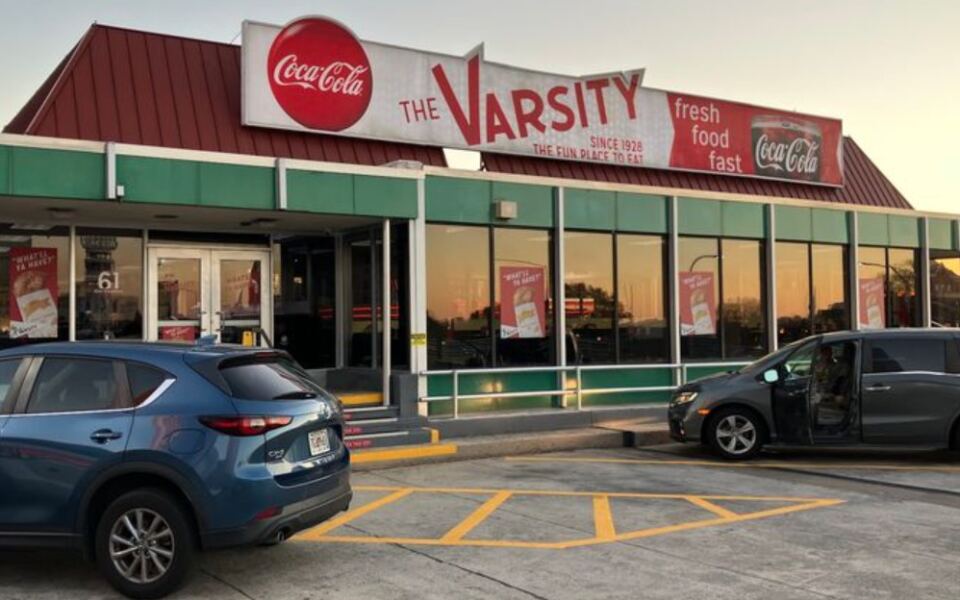
At The Varsity, a “steak” comes on a hamburger bun, “strings” means french fries, and the question “What’ll ya have?” is practically part of the menu. Before lunch reaches the tray, Atlanta’s famous North Avenue restaurant has already given newcomers a small vocabulary lesson.
The giant red V outside makes the introduction; chili dogs, onion rings, and a Frosted Orange handle the rest. Founded by Frank Gordy in 1928, The Varsity grew from a modest operation into a sprawling landmark across the Downtown Connector from Georgia Tech.
Its history includes singing carhops, football crowds, and customers who eventually returned with grandchildren. Yet this is also a working restaurant with an important modern distinction: the Atlanta location currently lists curb service as closed.
Understanding The Varsity means looking beyond the drive-in label to the people, food, and everyday rituals that made a quick meal become a lasting part of the city.
How The Varsity Became an Atlanta Fixture in 1928
Six stools don’t sound like the beginning of a restaurant that would eventually occupy two city blocks. They were enough for Frank Gordy to get started.
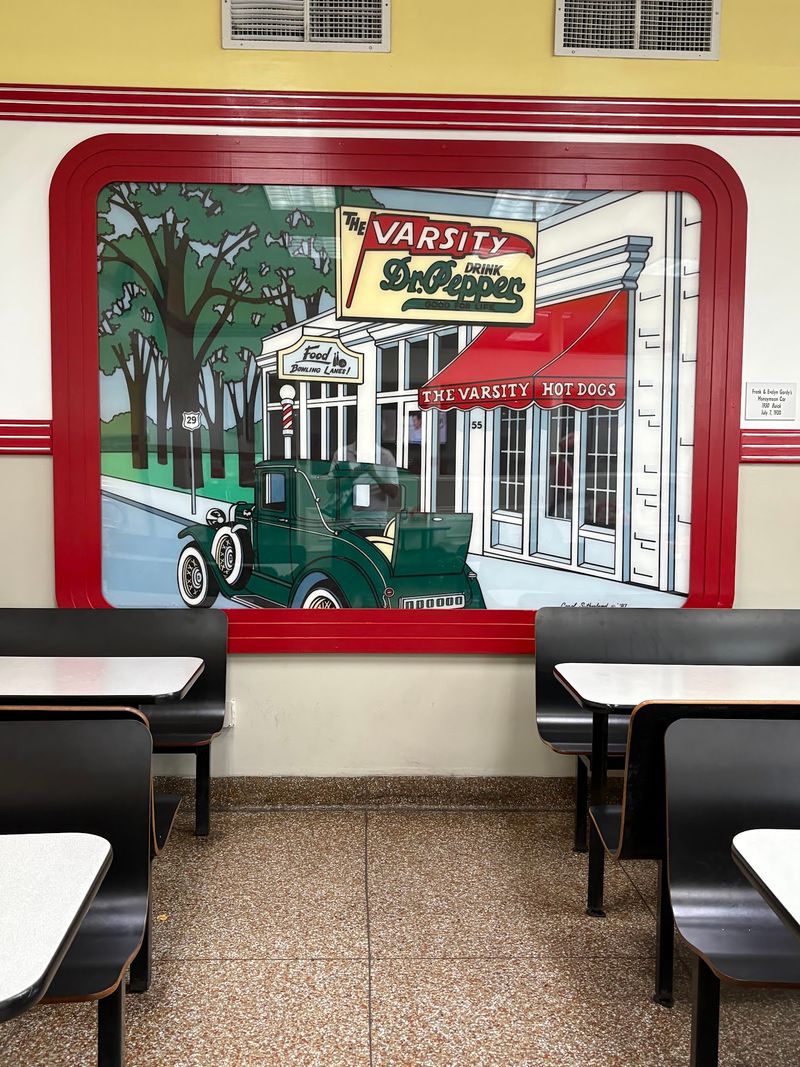
According to The Varsity’s company history, Gordy leased a house at 55 North Avenue in 1928 and built a 14-by-35-foot brick restaurant in its front yard. There was an indoor counter, a walk-up window, and a useful source of potential customers: the trolley stop at Peachtree Street and North Avenue.
The business served roughly 300 people on its opening day. That beginning puts the restaurant’s later reputation in perspective.
Long before enormous parking areas and highway visibility became part of its identity, Gordy was working with something much smaller and more practical: hungry people passing a convenient corner. Georgia Tech supplied another nearby audience.
The school’s students helped establish the connection between the restaurant and college life that still gives its name a particular local meaning. The building eventually began advertising speed through its architecture, too.
Around 1940, architect Jules Gray redesigned it in the Streamlined Moderne style, giving the structure curves and a more aerodynamic appearance suited to the automobile age. The earlier brick building remained beneath the newer exterior.
That detail is a useful way to understand the place. Its familiar appearance developed through additions and alterations, rather than arriving fully formed in 1928.
Even the restaurant’s relationship with transportation evolved, from trolley passengers and pedestrians to motorists and interstate traffic. Today’s address is 61 North Avenue, directly across the I-75/85 Connector from Georgia Tech.
What looks like an establishment built to catch passing drivers began by catching passing foot traffic. The scale changed dramatically; the value of being in the right place at lunchtime proved considerably more durable.
The Carhops Who Helped Define the Drive-In Experience
Picture ordering dinner through a car window and getting the menu sung back to you. For customers served by John Wesley Raiford, better known as Flossie Mae, that performance was part of the meal.
Raiford joined The Varsity in 1937 and developed a style that made him one of its most recognizable employees. Decorated hats and musical orders helped turn an ordinary transaction into something people remembered.
The restaurant’s carhops were central to its personality, giving a large operation individual voices and familiar faces. Another employee took that experience into show business.
Julius “Nipsey” Russell worked as carhop number 46 after World War II, using comedy to improve his tips. The future television entertainer later credited the job with helping develop his timing.
At a busy drive-in, apparently, even a punchline had to keep moving. WABE’s reporting during the restaurant’s 90th anniversary offers a more recent glimpse of that working world.
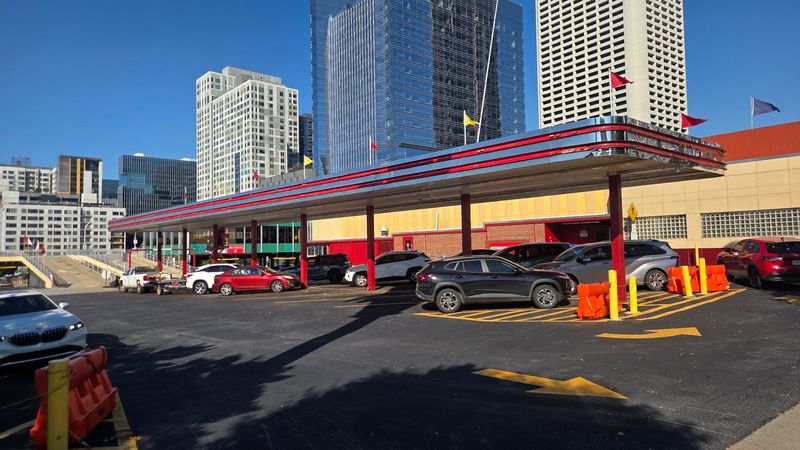
In 2018, the station interviewed Louis Frank Jones, then 87, who had spent more than 60 years taking orders as a carhop. Customers pulled up to red pillars, and an employee approached their window.
That distinction matters: the classic arrangement involved parking and being served, rather than following a drive-through lane. It also created room for conversation, recognition, and a little showmanship between orders.
Those encounters explain why the employees belong in the restaurant’s history alongside its founder and food. They supplied the human connection that a giant sign could never provide by itself.
Today, however, visitors should separate that history from the service currently available. The Atlanta restaurant’s official page says drive-through and curb service are closed.
The drive-in tradition remains essential to its identity, but the old car-window experience belongs to the story visitors learn about, rather than something they should expect to receive with lunch.
What “What’ll Ya Have?” Means at the Counter
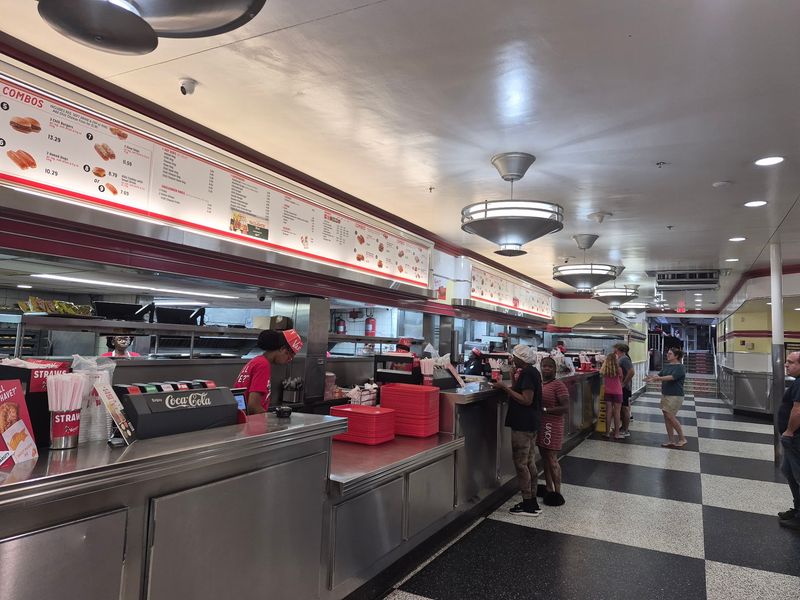
“Glorified steak” sounds like something that might require a reservation and a discussion about doneness. At The Varsity, it means a hamburger with mayonnaise, lettuce, and tomato.
The restaurant’s ordering language has its own logic, although a first-time customer could be forgiven for needing a translation. A “steak” is a hamburger with ketchup, mustard, and pickle; a “naked steak” is plain. “Strings” gets you french fries, while “ring one” means an order of onion rings.
There is considerable specificity hiding inside those short expressions. The hot dog vocabulary is particularly revealing.
On the official lingo page, a standard “hot dog” includes chili and mustard. A “naked dog” is simply the dog and bun.
A “red dog” adds ketchup, and a “yellow dog” adds mustard. Knowing that distinction helps prevent the understandable assumption that an unqualified hot dog order will arrive bare.
Meanwhile, “walk a dog” means a hot dog to go. No leash required.
Drinks receive similar treatment. “F.O.” stands for the Frosted Orange shake. Chocolate milk traditionally comes with ice, while “N.I.P.C.” specifies plain chocolate milk without it.
These are practical details as much as entertaining ones: the shorthand communicates toppings, preparation, and packaging in a few words. The greeting that starts the exchange serves the same purpose.
WABE reported in 2018 that employees were instructed to welcome customers with “What’ll ya have?” It is both a recognizable signature and a direct invitation to place an order. Read together, the question and the vocabulary capture the restaurant’s particular balance of speed and personality.
There is enough information here to get a meal exactly right, delivered with more character than a numbered combo alone can manage. Once “steak, strings, and F.O.” becomes understandable, the counter begins to sound considerably less mysterious—and lunch becomes a burger, fries, and an orange shake.
The Burgers, Chili Dogs, and Onion Rings Behind the Following
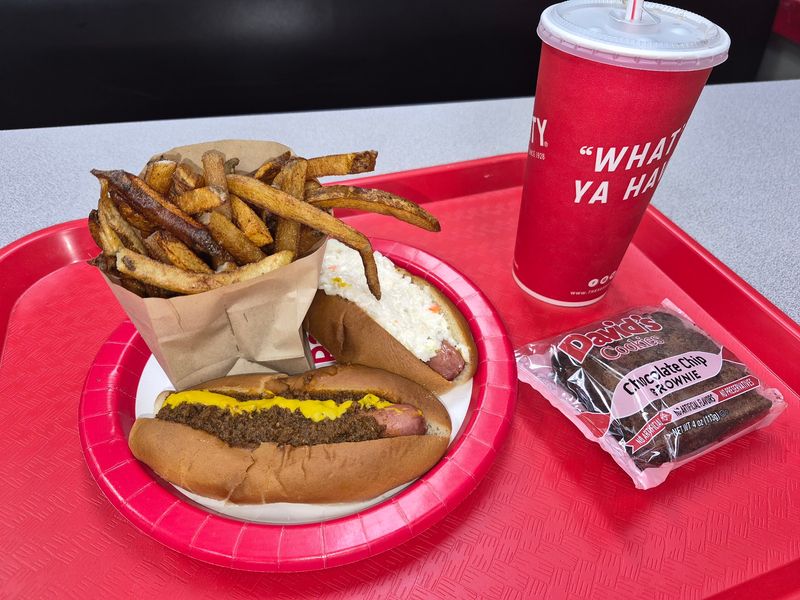
Southern Living’s recognition of The Varsity as one of the South’s beloved burger joints put the hamburger in the spotlight. WSB-TV reported the selection in February 2024, noting that it was the only Georgia restaurant on that particular list.
For a place so closely associated with chili dogs, that attention was a useful reminder: the burger belongs in this story, too. Its basic appeal is straightforward.
The classic “steak” pairs a hamburger with ketchup, mustard, and pickle, while other versions change the toppings. There is no elaborate explanation required before eating one.
The menu’s strength lies in recognizable combinations that leave customers with clear preferences to defend. Burger or dog?
Fries or rings? Chili or no chili?
The decisions are small, but they are precisely the sort that can become permanent family positions. Chili dogs and onion rings have an especially strong claim on the restaurant’s identity.
The Atlanta History Center singles them out among its best-known foods, and its “Atlanta in 50 Objects” presentation includes a Varsity combo meal on a carhop tray. That is a fairly unusual destination for a fast-food lunch.
Kitchen reporting adds another layer to the familiar order. During a 2018 visit, Garden & Gun documented fresh onion rings being battered and fried by hand, with care taken to keep them from sticking together.
The magazine also described a specialized chili spoon designed to spread chili evenly over a hot dog in one movement. Those details reveal the work behind a menu that looks uncomplicated from the dining room.
Serving familiar food repeatedly, at considerable volume, requires attention to consistency and preparation. The finished tray may look casual, but the production has to be organized.
Add a fried apple or peach pie, and the meal extends into dessert without abandoning the restaurant’s preference for food that is easy to order and easy to carry.
Why a Frosted Orange Belongs With Your Order
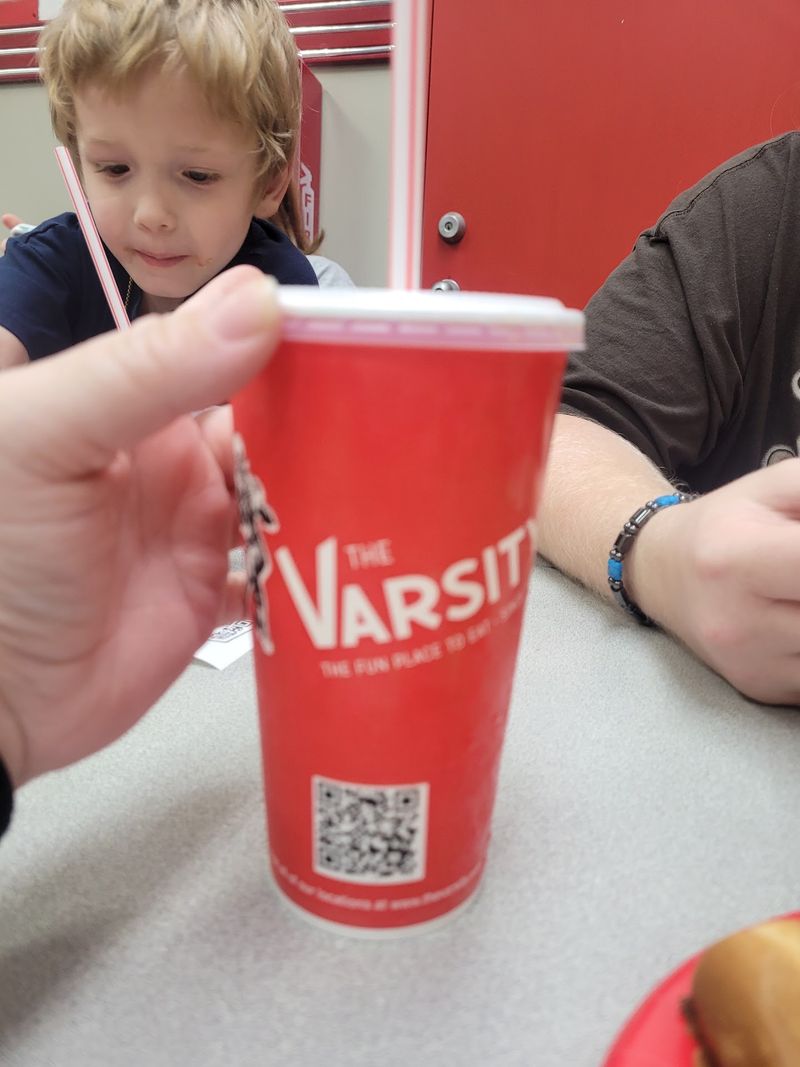
Two letters carry a surprising amount of responsibility on this menu: F.O. They identify the Frosted Orange, the restaurant’s orange-and-vanilla frozen specialty, and distinguish it from the separate Varsity Orange drink.
Confusing the two would mean missing a meaningful part of the order. One is the original orange beverage; the other brings the creamy, frozen character that has made the shake a signature.
Garden & Gun traced the Frosted Orange’s beginnings to a float combining Varsity Orange and vanilla ice cream. Its later form keeps that familiar flavor pairing, with the magazine comparing it to a Dreamsicle milkshake.
The association makes sense: orange supplies a bright citrus flavor, while vanilla gives it the dessert quality that makes a cup feel like more than a drink alongside lunch. Its production also reflects the restaurant’s ongoing need to make popular items efficiently.
FSR magazine reported that employees once hand-spun milkshakes and mixed in Varsity Orange. By the 1960s, demand had made that individual preparation impractical.
The beverage had become important enough to require a different production approach. That history gives the F.O. a place alongside the restaurant’s other carefully organized specialties, rather than treating it as a colorful extra.
On a tray with chili dogs or onion rings, it provides a cold, sweet counterpart to the savory food. Ordering one also changes the dessert calculation.
A fried peach pie and an orange shake are distinct pleasures, but the shake already brings vanilla sweetness to the meal before any pastry enters the picture. There is something appealingly decisive about that arrangement: dessert can start while the fries are still on the tray.
For customers learning the lingo, F.O. may also be the easiest abbreviation to remember. It is short, specific, and attached to a flavor combination that explains itself with the first spoonful.
How The Varsity Became a Tradition for Generations of Atlantans
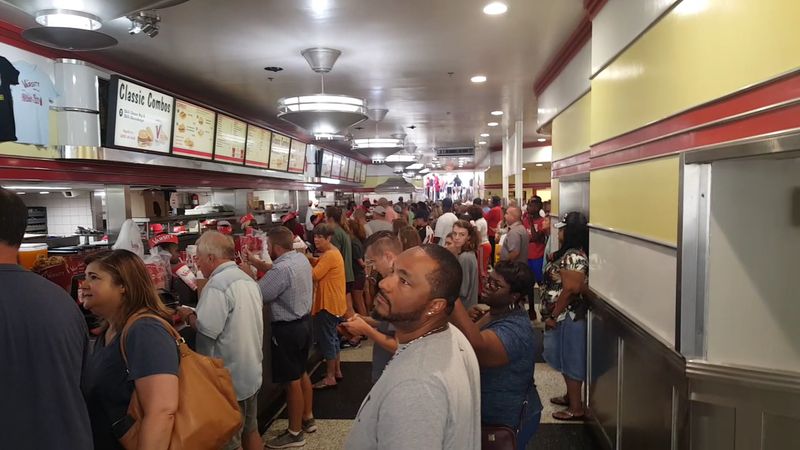
Across the Connector from Georgia Tech, a restaurant can become part of a football day almost by geography alone. Remaining part of people’s lives after graduation takes something more.
The Varsity’s connection to students and sports supplied countless introductions, but repeat visits helped turn those introductions into personal history. WABE captured that progression in its 2018 interview with John Simon, a customer from the Pittsburgh area.
He first visited in 1969 while stationed in Atlanta with the Army. Nearly five decades later, he was bringing his grandchildren when they came to the city.
That is a more revealing measure of longevity than the age printed on a sign. A restaurant becomes a tradition when someone decides that another person should experience it, too.
The Atlanta History Center’s inclusion of a Varsity meal in “Atlanta in 50 Objects” gives that private habit a public counterpart. A tray of food earned a place in an exhibition about the city because people recognized something of Atlanta in it.
The company’s own continuity has a family dimension as well. After Frank Gordy died in 1983, his daughter Nancy Gordy Simms took over; her son Gordon Muir joined the business in 1989.
Yet continuity should not be confused with the idea that every detail has remained frozen. The building expanded, customers increasingly ate indoors, and curb service is currently closed.
Acknowledging those changes makes the restaurant’s endurance more interesting. People have carried their attachment through different versions of the experience, from carhop orders to dining-room meals.
The familiar food and language provide points of recognition even as the setting evolves. For a returning customer, a particular order can connect an ordinary lunch to a first visit years earlier.
For the grandchild sitting nearby, it may simply be the day someone explained why a hamburger was called a steak.
Share this story